
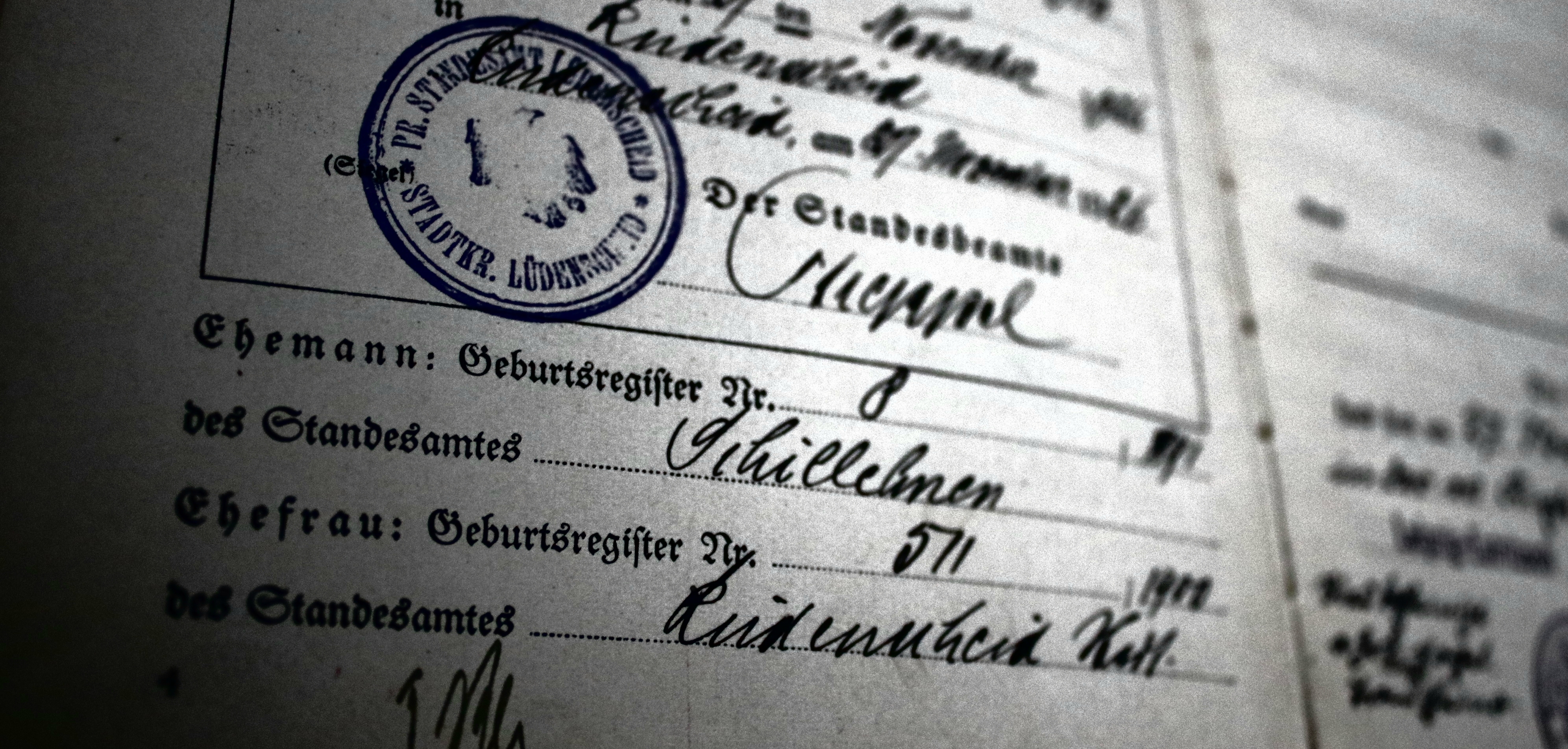
Am 1. August 2017 habe ich mich mal wieder dem Digitalisieren von alten Dokumenten gewidmet. Genauer gesagt habe ich die Nummer [00773] aus meiner Dilibra-Sammlung gescannt. Ein etwas älteres Familienstammbuch vom Verlag des Reichsbundes der Standesbeamten Deutschlands e.V. G.m.b.H., das auf den ersten Blick wohl Ende 1926 zum Zwecke der Eheschließung zwischen dem 35-jährigen Ostpreußen Heinrich DELINGAT und dessen 9 Jahre jüngere Verlobte Johanna Lydia GERMANN in Lüdenscheid angelegt wurde. Immerhin war der Bräutigam in spe ein waschechter Ingenieur. Wie man sieht, riskiert man also selbst beim Digitalisieren schon mal einen inhaltlichen Blick. Schöne Schriften, schöne Stempel. So weit, so gut.
Den Geburtsort des Bräutigams konnte ich zunächst nicht entziffern und mir fehlte auch irgendwie die Lust, noch großartig zu recherchieren. Also stellte ich exakt um 18.44 Uhr einen Bild-Ausschnitt in mein Facebook-Album Übersetzungshilfen und holte mir derweil eine kühle, grüne Glasflasche Märkisch-Kristall (nein, ich stehe dort nicht unter Vertrag) und hatte nach nur 4 Minuten bereits die Lösung. Der gute Heinrich ist nämlich in Alt Lubönen geboren. (Danke Sabine, Danke Matthias.)
Laut GenWiki von Genealogy.net ist Alt Lubönen „ein kleines Dorf auf dem südlichen Hochufer der Memel. Gegenüber auf dem nördlichen Memelufer liegt der Gutsbezirk Kassigkehmen. Alt Lubönnen ist heute eine Wüstung, das letzte Wohnhaus wurde 1992 abgerissen.“ Den Artikel zum Ort fand ich übrigens sehr informativ, nett bebildert und insgesamt gelungen. Alt Lubönen befand sich bis zuletzt im Kaliningrader Oblast in Russland und soll wohl Osjornoje geheißen haben. Laut WikiPedia handele es sich um einen untergegangenen Ort im Rajon Krasnosnamensk, der von 1938 bis 1946 auch Friedenswalde genannt wurde.
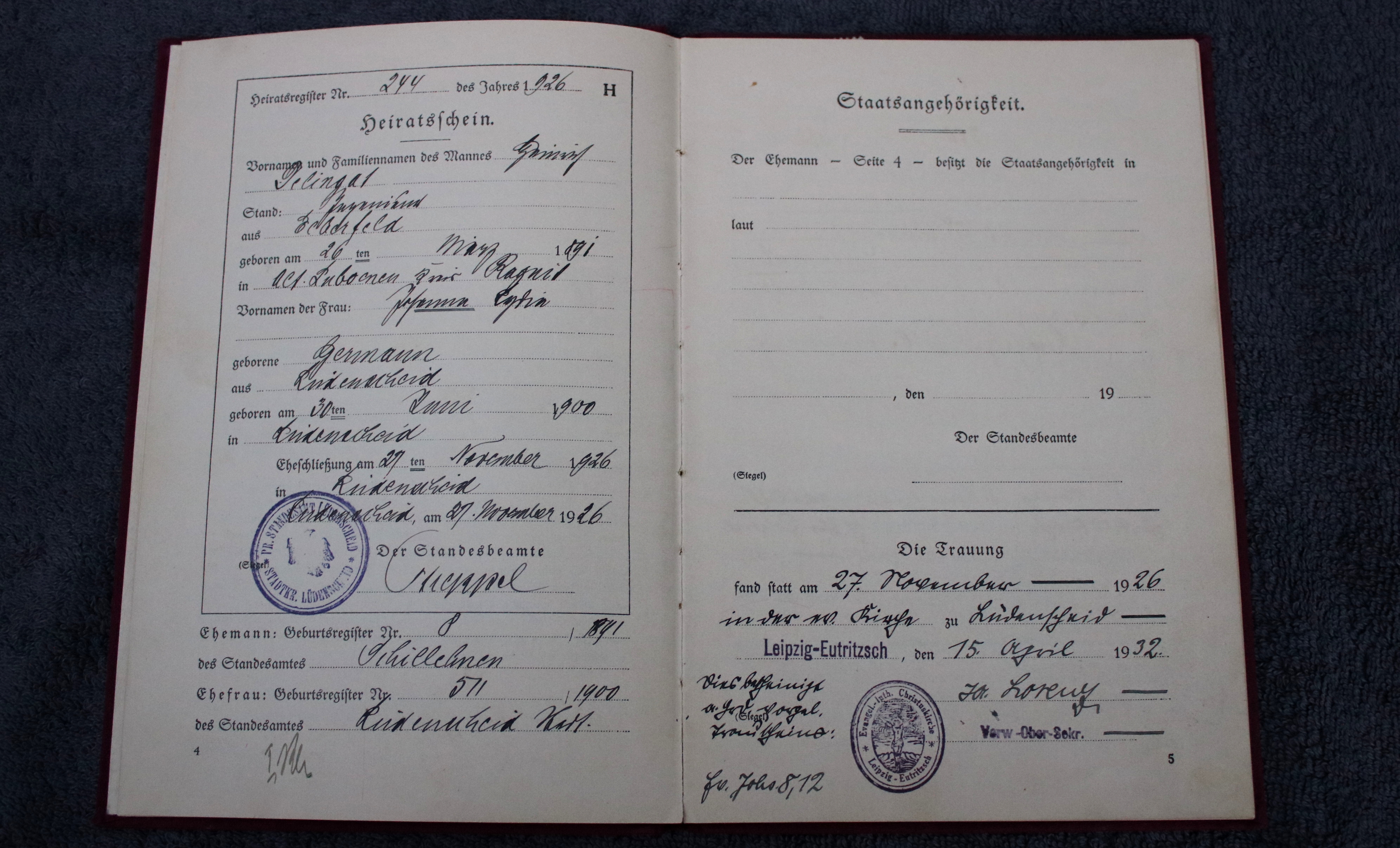
Da hatte ich nun alles beisammen, so dass sich letztendlich folgendes „Familienbild“ dem Stammbuch entnehmen ließ:
Der Ingenieur Heinrich DELINGAT, evangelisch, geb. 26.03.1891 in Alt Lubönen, Kreis Ragnit in Ostpreußen, Sohn der Eheleute Friedrich DELINGAT und Anna BURNATZKY (beide evangelisch), ehelichte am 27.11.1926 die Johanna Lydia GERMANN, evangelisch, geb. 30.06.1900 in Lüdenscheid, Tochter der Eheleute Friedrich GERMANN aus Beilstein (Westerwald) und der Lydia WORTMANN aus Lüdenscheid (beide evangelisch). Die kirchliche Trauung erfolgte am 27.11.1926 in der ev. Kirche zu Lüdenscheid und wurde am 15.04.1932 im Stammbuch von der evangelisch-lutherischen Christuskirche in Leipzig-Eutritzsch von Verwaltungsobersekretär LORENZ bescheingt. Der Ehe entstammt die gemeinsame Tochter Rotraut Julianne DELINGAT, geb. 28.01.1932 in Leipzig. Sie wurde am 18.04.1932 in der ev.-luth. Christuskirche in Leipzig-Eutritzsch getauft. Taufpaten waren Herta GOOSMANN aus Hamburg und Kurt GERMANN aus Lüdenscheid in Westfalen. Heinrich DELINGAT starb – einem nicht offiziellen Eintrag zufolge – am 19.04.1956 in Wuppertal-Elberfeld (dort wohl auch bestattet).
Nachfahren und Verwandte, die hier anknüpfen können, dürften sich über die weiteren Puzzleteile in dieser (irgendwie niemals enden wollenden) Forschungsarbeit freuen. Mich betraf es nicht, ich freute mich dennoch. Nämlich über den unscheinbaren Eintrag: Standesamt Schillehnen, denn dessen Register gelten wohl als verschollen. Der Albtraum eines jeden Forschers! Umso wertvoller sind die gewonnenen Details, da sich anhand dieses Familienstammbuches zumindest das Geburtsregister Nr. 8 aus dem Jahr 1891 wie folgt rekonstruieren lässt:
Heinrich DELINGAT, geb. 26.03.1891 in Alt Lubönen, Sohn der Eheleute Friedrich DELINGAT (ev.) und Anna BURNATZKY (ev.)
Und wieder ein Stück Geschichte bewahrt.
Quellen:
- Familienstammbuch, https://www.dilibra.com/ahnenforschung/1345/
- http://wiki-de.genealogy.net/Alt_Lub%C3%B6nen
- Standesamt Schillehnen, Geburtsregister Nr. 8/1891 (die Register gelten als verschollen)
- Standesamt Lüdenscheid, Geburtsregister Nr. 511/1900
- Standesamt Lüdenscheid, Heiratsregister Nr. 244/1926
- Standesamt Leipzig I, Geburtsregister Nr. 389/1932


Smart Communications
Globe Telecom
Smart Communications
Globe Telecom
Smart Communications
Sun Cellular
Sun Cellular
Globe Telecom
Sun Cellular
Sun Cellular
Smart Communications
Globe Telecom
Smart Communications
Sun Cellular
Globe Telecom
Globe Telecom
Smart Communications
Globe Telecom
Globe Telecom
Smart Communications
Smart Communications
Sun Cellular
Sun Cellular
Smart Communications
Sun Cellular
Smart Communications
Globe Telecom
Smart Communications
Smart Communications
Globe Telecom
Globe Telecom
Globe Telecom
Smart Communications
Smart Communications
Smart Communications
Sun Cellular
Smart Communications
Smart Communications
Globe Telecom
Smart Communications
Globe Telecom
Globe Telecom
Smart Communications
Smart Communications
Smart Communications
Smart Communications
How Are Electoral Votes Calculated?
The United States electoral system can often seem intricate and shrouded in complexity, particularly for those not deeply versed in political science. A key component of this system is the Electoral College, which is paramount in determining the outcome of presidential elections. Understanding how electoral votes are calculated not only demystifies the election process, but also reinforces the importance of civic engagement in democratic systems.
In this article, I aim to elucidate the method by which electoral votes are assigned and distributed among the states, discuss the implications of this system, and answer some frequently asked questions.
The Structure of the Electoral College
The Electoral College consists of 538 electors, with a majority of 270 votes needed to win the presidency. Each state’s number of electors is equal to the total number of its Senators and Representatives in Congress. Consequently, all states are represented by at least three electors—two Senators and at least one Representative.
Table 1: Distribution of Electoral Votes by State
State
Number of Electors
State Population (est.)
Alabama
9
5,024,279
Alaska
3
733,391
Arizona
11
7,151,502
California
55
39,538,223
Florida
29
21,538,187
New York
28
20,201,249
Texas
40
29,145,505
Wyoming
3
576,851
Total
538
This electoral vote distribution is recalibrated every ten years following the census, as population shifts can lead to changes in congressional representation.
How Are Electoral Votes Calculated?
The process can be broken down into a few simple steps:
Census and Apportionment: Every ten years, the U.S. conducts a census that counts the population of each state. The data collected from the census not only informs federal funding but also the apportionment of congressional seats and, subsequently, electoral votes.
State Allocation: Based on the apportionment from the census, states are assigned electoral votes proportional to their respective populations. For instance, larger states like California and Texas have more electoral votes compared to smaller states like Wyoming and Vermont.
State Electoral Processes: Generally, states employ a winner-takes-all system, where the candidate who wins the majority of the popular vote within that state receives all of its electoral votes. This is the case in 48 states, with Maine and Nebraska being the exceptions, employing a proportional distribution of votes.
Certification: After the presidential election, each state verifies and certifies its results, affirming the electoral votes won by each candidate. These certified votes are then submitted to Congress.
The Role of Public Opinion
It is essential to recognize that while the electoral vote system is designed to represent the population, it also reflects the political landscape of each state. The winner-takes-all system can lead to controversial outcomes, where the popular vote winner may not secure the presidency due to the distribution of electoral votes.
Implications of Electoral Votes
The Electoral College system has significant implications for campaign strategies and voter engagement. Candidates focus on swing states—those in which no single candidate has overwhelming support—rather than concentrating solely on areas with dense populations. This results in political resources being allocated unevenly, potentially leading to voter disenfranchisement in areas considered „safe“ for one party or the other.
Frequently Asked Questions (FAQs)
1. How many electoral votes does my state have?
To determine your state’s electoral votes, refer to the current apportionment table—remember that this is influenced by the most recent census.
2. What happens if no candidate receives 270 electoral votes?
If no candidate wins the necessary 270 electoral votes, the election is decided by the House of Representatives, where each state delegation casts one vote for one of the top three candidates.
3. Why do some states have more electoral votes than others?
Electoral votes are based on the number of congressional seats assigned to each state, which in turn depend on the state’s population as measured in the census.
4. Why do we use the Electoral College instead of a direct popular vote?
The Founding Fathers established the Electoral College as a compromise between electing the president by a vote in Congress and by popular vote. It was designed to balance the influence of populous states with less populous ones.
5. How does the winner-takes-all system affect elections?
This system can lead to a discrepancy between the popular vote and electoral results, as it concentrates campaign attention on battleground states rather than reflecting the nationwide popular support for a candidate.
Conclusion
Understanding how electoral votes are calculated and allocated is essential for grasping the broader context of the American electoral system. The interplay between population, political strategy, and state representation shapes the electoral landscape in complex ways. By exploring these mechanisms, I hope to encourage more informed and engaged citizens, fostering a deeper appreciation for the democratic process that shapes our nation.
Informed citizens are essential for a healthy democracy. I encourage everyone to partake in discussions about their electoral rights and responsibilities, as these discussions are vital for maintaining the integrity of our political institutions.